
How Should Equity Between Founders Be Structured?
Open with the equity split. Most operators starting a partnership get this wrong because they get it fast. Review this first.
Six pieces on first equity split, first agreement, formation choice, authority structure, the decision spine, and the cost of the deferral that feels cheap.
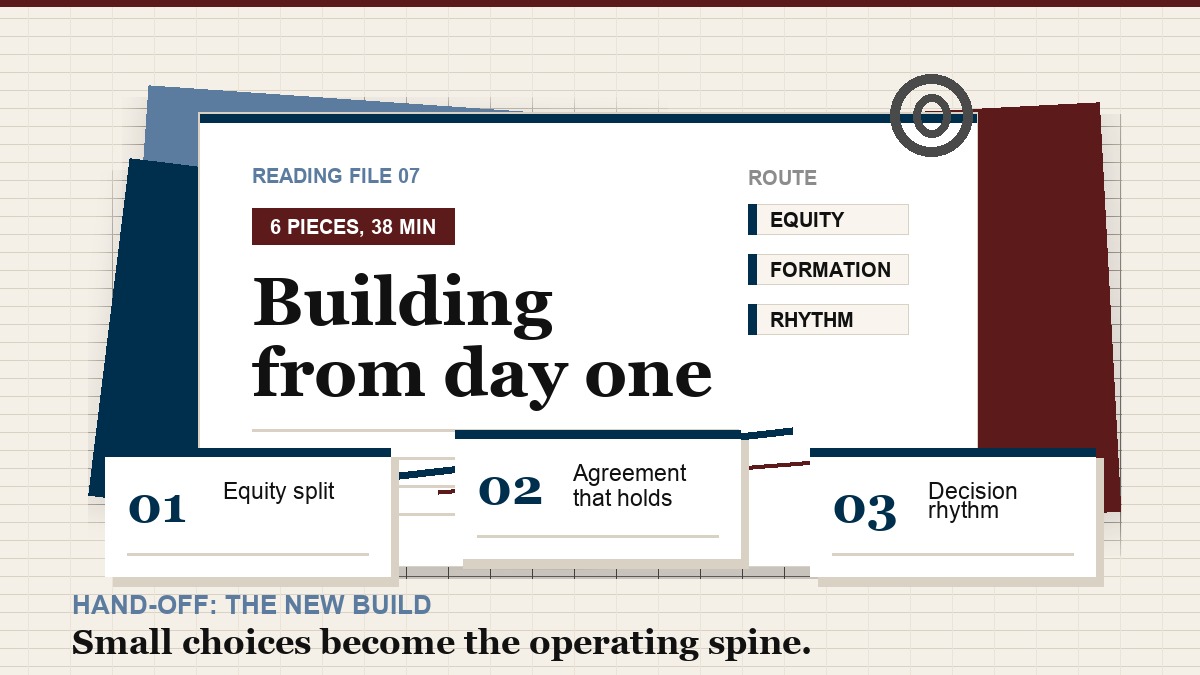
Each piece sharpens the same pressure from a different angle. The bridges tell you why the next piece belongs here and where the full path opens after the sequence.
Day-one choices look small because the company is small. They are not small. Equity split, formation, partnership agreement, authority structure, and decision-closing rhythm each compound for as long as the company exists. The sequence walks the order in which these choices are best made, with the bridges that explain why one sets up the next. It ends on the essay every operator at month one should use and most do not find until month forty-eight: the price of treating the deferred decision as cheap.
Open with the equity split. Most operators starting a partnership get this wrong because they get it fast. Review this first.
Equity split is the number. The partnership agreement is the structure that survives a real disagreement. This is the agreement that holds three years from now, not today.
Two founders inside an LLC is one shape. Two founders inside a Delaware C-corp with a vesting schedule is a different shape. This guide explains the formation choice in operator terms.
Formation set, the next question is authority. Two founders, equal title, equal vote, makes most decisions impossible to close. This essay names why and what to do about it.
Authority structured, the next layer is the decision spine itself. This framework is built from 21 years of operating, condensed to what a founder uses on a Monday morning.
Closing piece. The single biggest mistake at day one is assuming you have time. This essay is the price of that assumption, written for an operator who has not made it yet.
Day-one decisions look small because the company is small. They are not small. A wrong decision at month one becomes a five-year liability at year five and a sale-killer at year seven. The cheapest version is the deliberate one, taken now, while it still costs nothing to take.
The seven-stage roadmap for this situation. Where you are in the arc and what the next move costs.
Review the path → If you want to keep reviewingOne business problem in each issue, with its cause and what to check next.
Subscribe → If you want private coachingStan confirms the people, stakes, scope, and fee in writing before larger work starts.
Request scope →