Glossary

Signing Authority: Titles, Signature Lines, and Contract Limits

Updated

A title in a signature block identifies the signer and role. It does not, by itself, prove authority for every contract, category, or dollar amount.

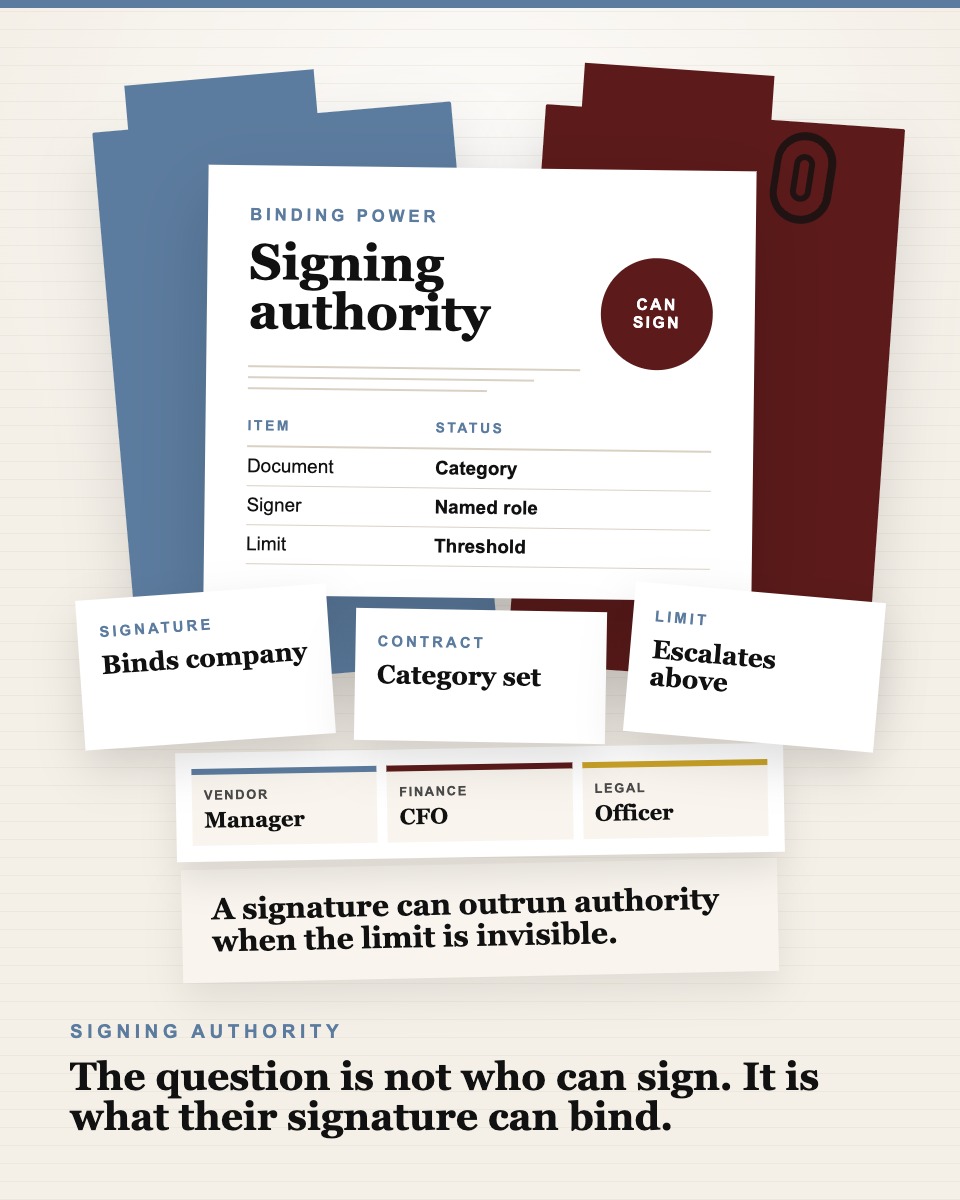
Governance table visual showing a signing authority resolution, signature block list, and contract category card.
Reference shelf. Governance terms in plain English.

Plain definition

What it means.

Signing authority concerns who may sign on the company's behalf and for which transactions. Internal authority can be expressly granted or implied from instructions and responsibilities. Governing documents, resolutions and delegation policies help establish and record its scope, including contract categories, limits and required approvals.

Common categories include commercial contracts, vendor agreements, employment offers, financial commitments, real estate transactions, intellectual property assignments, and government filings. Different categories often carry different signing rules, sometimes requiring two signatures, board resolution, or external notarization.

A signature identifies an act of signing. Whether it binds the company depends on authority, the transaction and applicable law.

Title versus authority

What the title and signature line do.

A contract signature block usually records the company, the signer's name, and the signer's title. That identifies who signed and in what stated role. The underlying authority still comes from the company's governing documents, resolutions, or delegated-authority rules.

This distinction matters because authority can be expressly granted, while a counterparty may also rely on conduct that appears to show authority. Cornell Law School's Legal Information Institute explains actual authority and apparent authority as separate agency concepts.

Boundary: This is general business information, not legal advice. Authority and enforceability depend on the governing documents, the transaction, and applicable law. Have qualified counsel review a real signing-authority dispute or policy.

A signature line still needs an authority check.

Illustrative example: a supplier agreement identifies “Example Manufacturing LLC” as the contracting party. Its signature block records “By: Alex Morgan; Title: Operations Manager; Date: November 7, 2026.” These are fictional names and descriptive fields, not a legal template.

Those fields show who is signing and in what stated role. Before signing, check the exact company and contract version, the current authorization for that contract category, the total commitment over the term, and any required second approval or signature. An operations manager allowed to approve routine purchases may still need approval for a multiyear supply commitment.

If the authorization is missing or does not cover the agreement, obtain a decision from the properly authorized person. Changing the title in the signature block does not create the missing authority. Keep the approval evidence with the signed agreement.

What goes wrong

Where this term becomes expensive.

The situations below are illustrative, not reported client engagements.

The founder who signed everything

In the early stage, the founder signs every document. As the company scales, the routine continues without formal documentation of who else can sign and at what level. New leaders cannot transact without the founder's signature. The founder becomes the approval point, and any travel or absence delays normal operations.

The signature without the authority

A senior leader signs a vendor agreement assuming they have signing authority for that category. The delegation of authority did not actually grant that authority. The vendor proceeds. The contract is later challenged. The company may be bound, the leader may have personal exposure, or both.

The two-signature requirement that nobody followed

The bylaws require two signatures for commitments above a defined threshold. A series of single-signature commitments are made above the threshold. The CFO discovers the pattern in a year-end audit. The missing second signature exposes a control failure. Whether a particular contract nevertheless binds the company depends on the authority, the company's conduct, the counterparty's reasonable reliance and applicable law; the internal failure alone does not settle it.

The departed officer whose signature still appeared

A former officer's signature blocks remained in template documents. New contracts were signed using the old officer's name electronically because the templates had not been updated. The contracts may be enforceable or contestable depending on the jurisdiction and the counterparty's reliance.

Business owner questions

Common owner questions.

What documents typically require signing authority? Commercial contracts, vendor agreements, employment and separation documents, real estate transactions, financing documents, intellectual property assignments, regulatory filings, and government agreements all typically require signing authority. Different categories often carry different signing rules with different role requirements.
How does signing authority differ from delegation of authority? Delegation of authority defines the underlying right to make decisions on behalf of the company across many categories. Signing authority is the specific subset that governs who can bind the company by signature. A person may be allowed to approve an expense while another person is authorized to execute its contract.
What is apparent authority? Apparent authority can arise when a counterparty reasonably understands, from the company's conduct, that a person may act for it. A title or the signer's own assertion does not settle every transaction. The scope of the apparent authority and the surrounding facts matter.
When does a contract bind the company even if signed without proper authority? There is no universal answer. Apparent authority or other legal grounds may bind a company despite an internal authority problem. Good faith alone is not the complete test for apparent authority: the company's conduct, reasonable reliance, transaction and applicable law need examination. Qualified counsel should assess the particular contract.

If signing authority is unclear, drifting, or has produced contracts the company cannot trace cleanly, that is a different conversation.

The work can examine current authority rules, the contract categories involved and where approvals or signatures are delaying the business. Legal questions about enforceability remain with qualified counsel.