
The board exists after the decisions are already made
Management presents decisions as updates. The board formally approves what has already become irreversible.
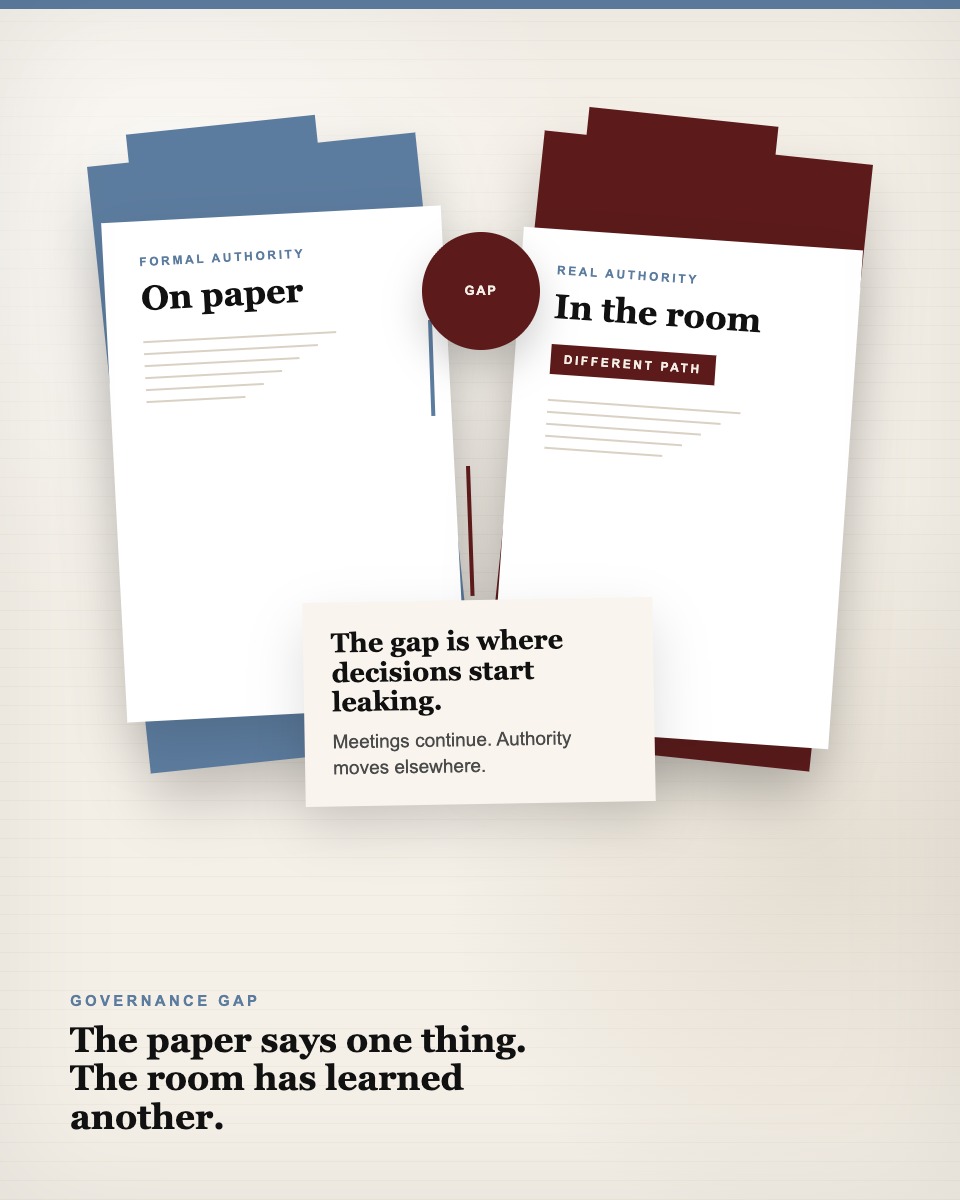
The governance gap is the distance between formal authority and the way decisions actually move inside the company.
Plain definition
The governance gap appears when documents, titles, board structures, and operating behavior no longer match. On paper, the company has a clean structure. In reality, decisions move through habit, personality, pressure, or workaround.
This usually happens during growth. The company adds people, capital, geographies, family members, board seats, or senior hires faster than it updates how authority works.
The governance gap is where the company outgrows the decision system that used to carry it.
What goes wrong
Management presents decisions as updates. The board formally approves what has already become irreversible.
Titles change. Executives arrive. Committees appear. The company still waits for the founder before it moves.
New layers are added without decision rights. Every level now needs more meetings to find out who can decide.
The company looks governed during normal weeks. Under pressure, everyone discovers the real authority map was informal.
Business owner questions
In practice
Decision rights are the first place to inspect when the governance gap starts costing speed.
Related structure Consent RightsConsent rights can widen the governance gap when documents require approvals the operating team does not understand.
Related structure The Governance GapThe Governance Gap essay expands the same pattern across growing companies.
Related pages
The deeper essay on how companies outgrow their decision structure.
Related pagesThe inflection points where growth starts requiring governance.
Related pagesThe drift signal that often appears before the dashboard catches up.
Use the definition to understand the mechanism. If the issue is now affecting ownership, authority, timing, or trust, treat it as a business decision before choosing the next document.
Work with Stan
Start with Work with me for monthly 1:1 business work, or request scope when the issue involves board, ownership, partner, leadership, or larger collaboration.