Product · active
The manual makes you good at running AI. This playbook draws the harder line: the narrow set of decisions where putting a model in the business helps, and the larger set where it quietly makes the call worse. Built from the engagements where the answer actually mattered, not from theory about what AI might do.
Apply for business coaching Read the manual it comes from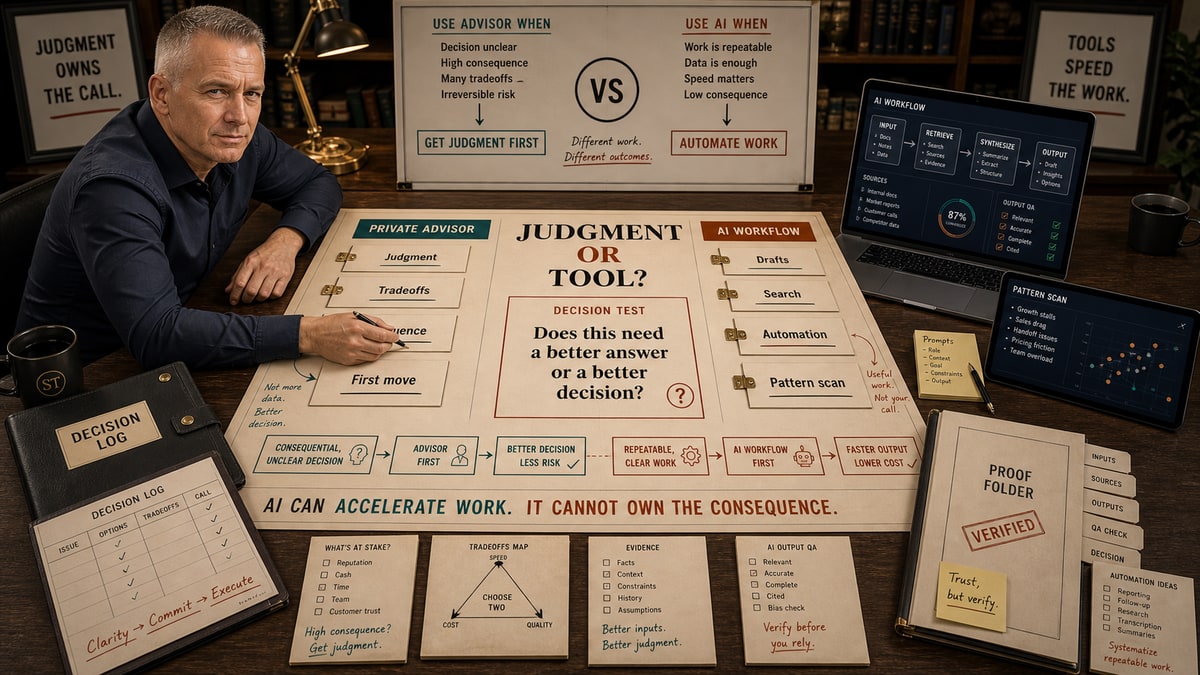
What it is
The AI-in-the-decision-setting Playbook is a worked guide to one question: when a real decision is under consideration, should a model be in the business at all. The answer is yes more rarely than the current noise suggests, and the playbook draws the boundary with cases instead of opinions.
It maps the decisions where a model earns its seat, the decisions where it should draft and then leave, and the decisions where its presence skews the business and should be kept out entirely.
The manual's last section names the line and points across it. This product is what lives on the far side: the detailed review on where the model adds signal and where it adds fluent noise that the business mistakes for signal.
It is built from engagements where the wrong call cost real money or real people, so the boundaries are drawn from outcomes, not from a framework someone liked the shape of.
What is inside
01 · Model in the business
Reversible calls, wide option sets, and questions where breadth beats depth. The model widens what you consider and stress-tests what you have already decided. The playbook shows the handful of decision types where this holds, with the engagements that prove it.
02 · Draft, then leave
The model builds the memo, the options, and the first draft. Then it leaves, because the decision turns on judgment it cannot hold: timing, relationships, what the numbers do not say. The playbook marks the exact handoff point.
03 · Keep it out
Irreversible calls, loaded settings, decisions where a fluent wrong answer is more dangerous than no answer. The playbook names the tells that a model is skewing the business and the cost when nobody catches it.
Who it is for
If you run the manual's process well and now reach for a model on bigger calls, this is the guide to where that instinct helps and where it quietly costs you. It assumes you can already get clean output. The question it answers is whether the output belongs in the business at all.
This playbook is for the operator who already uses AI and risks trusting it on the one call where the model should have stayed out.
Use it now
Use the playbook shape to decide whether AI belongs in the business at all: draft zone, adversary zone, or no-model zone. The value is the boundary, because fluent output near a real decision can make a weak call sound finished.
The three zones come from engagements already run. Use the zones to decide where AI belongs now, and where it should stay out of the business.
Use the three zones to set the boundary before a model enters the work. Use coaching when a decision lands in the no-model zone and still has to be made.
What this is not
Knowing that a decision sits in the keep-it-out zone tells you to stop reaching for the model. It does not make the decision. The hardest calls, the ones the playbook flags as model-out, are exactly the ones where business coaching earns its cost. The manual names that line; the coaching is where it gets crossed.
Back to the manual →When the work is live
Stan reviews each request for fit. Stan confirms the people, stakes, scope, and fee in writing before larger work starts. The page identifies where AI belongs; an engagement reviews the live decision that remains.
Apply for business coachingWork with me · $1,500/month 1:1 business work · Request scope
