Product · active
A view trips a threshold. Then what? This is the library of worked examples: the moment a number crossed a line, the decision that followed, and how it turned out. Anonymized, structural, built from real reviews. It teaches the part the templates cannot, which is what to do when the books finally tell you something.
Apply for business coaching Read the manual it comes from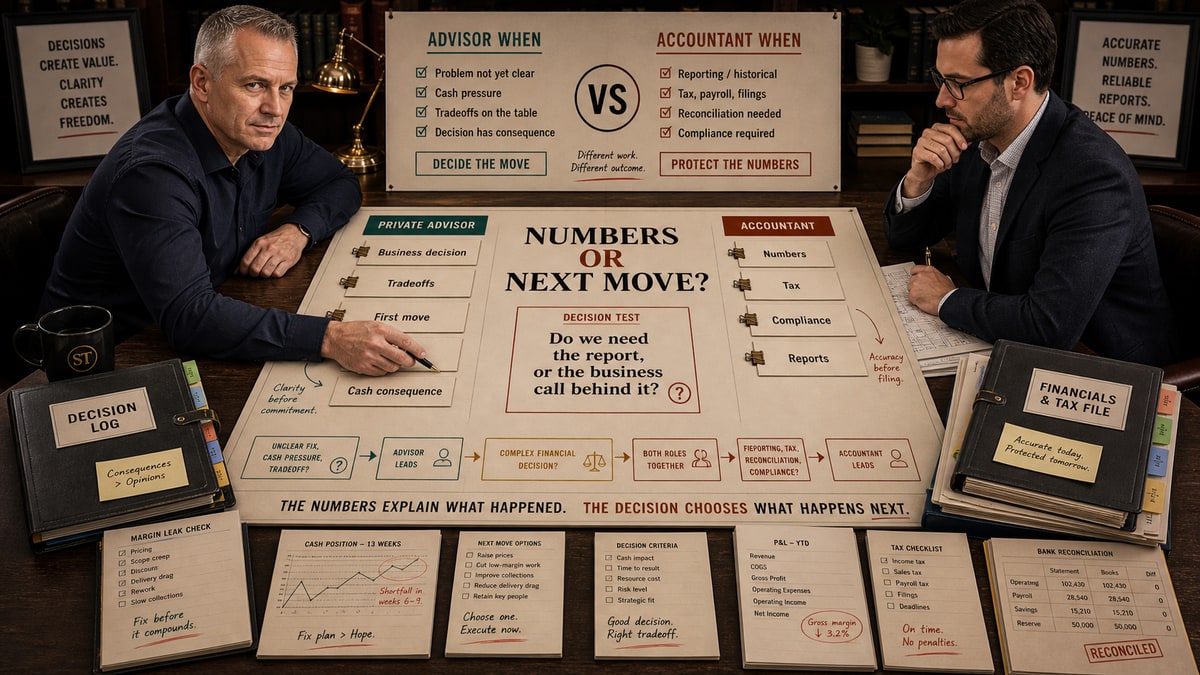
What it is
The Decision-Behind-the-Books Library is a collection of worked examples, each one built on the same shape: a view surfaced something, a decision had to be made, and the review changed what happened next. The margin point that turned out to be a pricing failure. The customer who crossed 25% and the relationship review that followed. The cash week that should have triggered a call eight weeks earlier.
It is the gap between seeing a number and knowing what it means, filled with real cases instead of theory.
The five views are good at producing signals. Owners get stuck one step later: the number is on the screen, it looks bad, and the next move is not obvious. A template cannot teach that move. A library of what other operators actually did, and what it cost or saved, can.
What is inside
01 · The signal
The exact number that crossed a line. Margin down a point, a customer past concentration, a cash week under the floor. Anonymized, but real, with enough detail to recognize it in your own books.
02 · The review
The structural cause, not the obvious one. Revenue up with margin down was not a win, it was a mix shift. The cause is the part most owners review wrong.
03 · The decision
What the owner chose, what they passed on, and why. Including the cases where the right answer was to wait, which the numbers alone never tell you.
04 · The outcome
How the decision aged. The cases where the early review saved the quarter, and the cases where acting too fast on a noisy signal was its own mistake.
Who it is for
If you pull the five views every month and keep landing on the same wall, the number is clear and the next move is not, this is the library that teaches the move. It assumes you are already doing the review. It is the pattern set that sits behind it.
It is not an introduction to reviewing your books. Start with the manual and the pack. Come here when the signals are showing up and you want to see how other operators review the same shapes.
Use it now
Use the case-library shape to understand what a five-view review should change: pricing, cash timing, customer concentration, working capital, or the question you take back to the accountant.
The cases come from engagements where the review changed a decision. If your books are clean but the decision under them is not, apply. That is where the review becomes useful now.
What this is not
Seeing how ten operators review a margin slip sharpens your judgment. It does not tell you what your margin slip means in your business, with your customers and your constraints. The library is calibration. The decision is still yours, and the hardest ones are where business owner coaching earns its cost. The manual names that line, and the coaching is where it gets crossed.
Back to the manual →Use this with
Monthly review
Run the five views first so the example has a real number to attach to.
Input cleanup
Clean the layout when the review keeps dying before the signal appears.
Manual
Keep the examples tied to the full monthly operating method.
When the work is live
Stan reviews each request for fit. Stan confirms the people, stakes, scope, and fee in writing before larger work starts. The page provides the repeated patterns; an engagement reviews the live numbers and decision.
Apply for business coachingWork with me · $1,500/month 1:1 business work · Request scope
