
Can a fractional CFO scale with the company?
Sometimes. Some fractional CFOs grow into full-time roles; others stay fractional and the company eventually hires elsewhere. Plan for either outcome from the start.
Comparison · Direct verdict
Direct verdict
Use a fractional CFO when the company needs senior financial judgment before it has full-time financial complexity. Hire a full-time CFO when finance has become a standing leadership function. The costly middle is not a revenue band. It is the moment the owner keeps buying reports when the business needs authority.
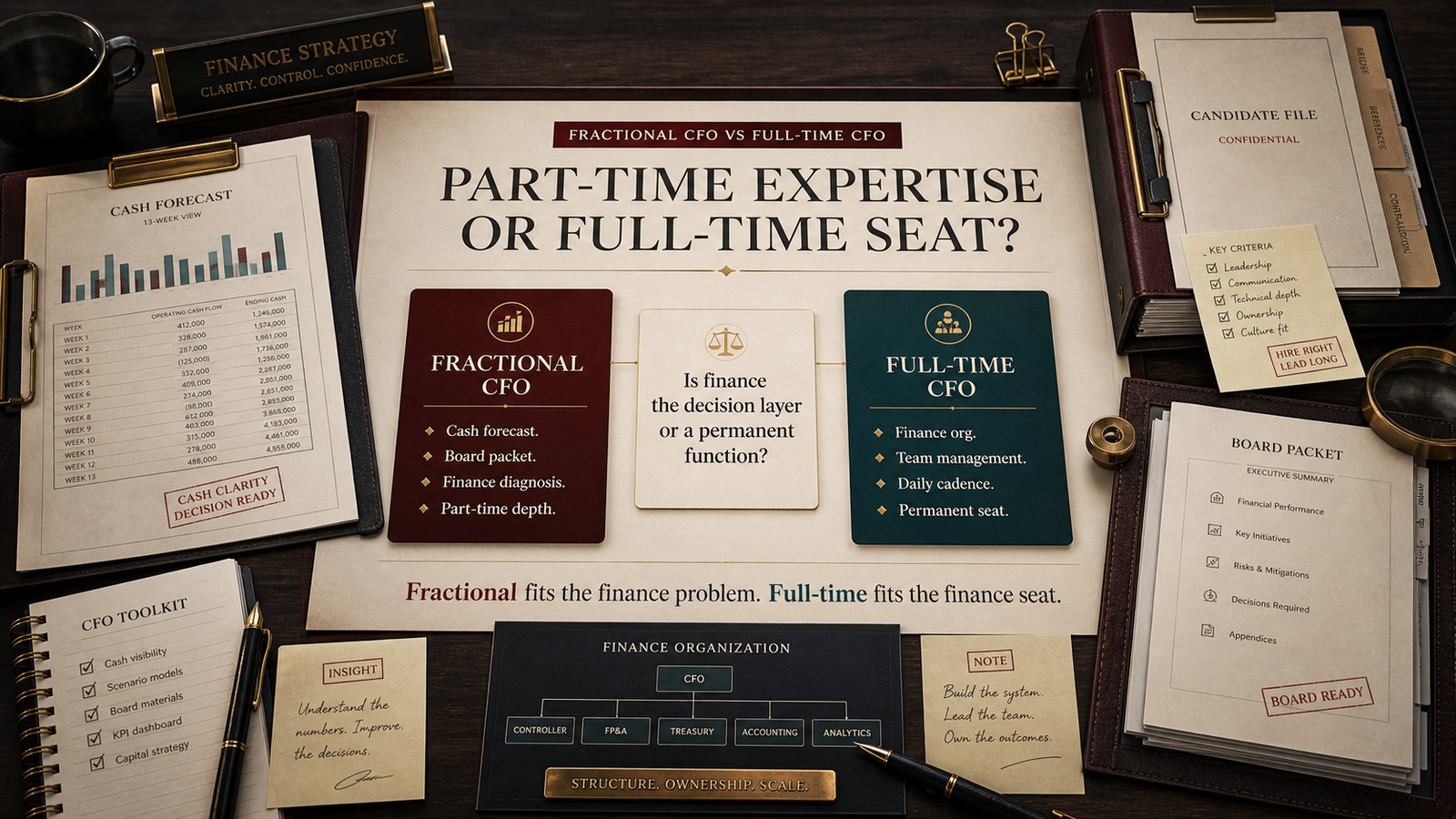
If finance needs senior judgment in bursts
Use this when forecasting, cash planning, lender preparation, or a capital event needs sharper financial thinking, but the company does not yet need a finance leader every day.
If finance is now a leadership function
Use this when capital, board reporting, treasury, lender relationships, and working-capital decisions need one accountable executive, not a monthly visitor with a spreadsheet.
Periodic judgment without permanent finance authority
Standing leadership for capital and control
When neither fits
When the owner wants a CFO title to make messy numbers feel grown-up. Under $1M revenue, a bookkeeper plus tax accountant usually covers the work. A CFO at that scale often creates analysis nobody uses while the same cash headache remains.
| Dimension | Fractional CFO | Full-Time CFO |
|---|---|---|
| Engagement shape | 1-3 days per week | Full-time role |
| Cost | $8K-$20K per month | $200K-$400K+ per year fully loaded |
| Time to value | 8-12 weeks | 6-12 months |
| Right at revenue | $1M-$5M | $15M+ |
| Transition zone | $5M-$15M depends on capital activity | $5M-$15M depends on capital activity |
| Risk of mismatch | Low; defined engagement | High; bad hire is 12+ months to unwind |
Sometimes. Some fractional CFOs grow into full-time roles; others stay fractional and the company eventually hires elsewhere. Plan for either outcome from the start.
When revenue exceeds $15M, when capital markets activity is continuous, when board reporting demands weekly financial discipline, or when treasury and lender relationships need standing leadership. Any single trigger justifies the hire; multiple triggers makes it overdue.
Usually no. A bookkeeper plus a tax accountant covers most of the work at that scale. A fractional CFO at that revenue level often produces analysis that nobody implements.
Yes, for the duration of the event. Many companies hire a fractional CFO specifically for fundraising or sale preparation, then either upgrade to full-time or release the role after the event.
For the structural pattern beneath this comparison, use Atlas: Capital.
Business owner coaching separates reporting need, cash pressure, capital timing, and standing authority before you buy the wrong finance role.
Work with Stan All comparisons