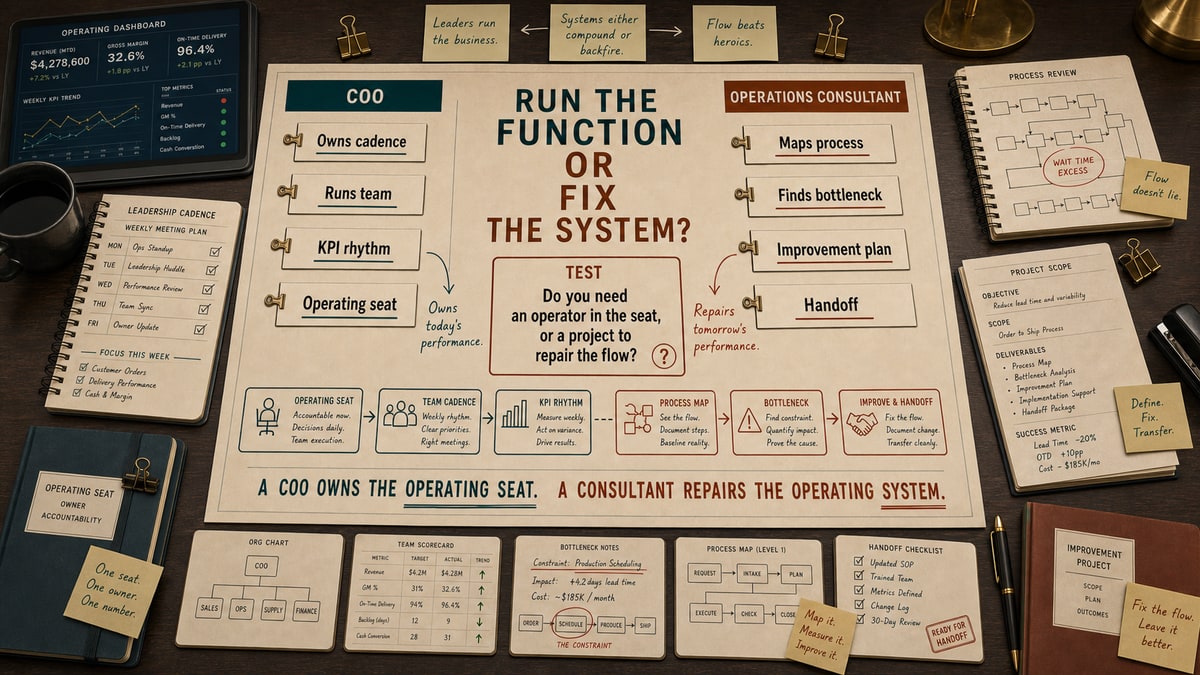
Hire a COO when the company needs standing operational authority. Hire an operations consultant when one defined operating constraint needs to change. If the founder has not named the constraint, both options can become an expensive role mismatch.
A COO owns the operating cadence. A consultant repairs one operating constraint.
If operations need a permanent owner
COO
The question is not whether processes are messy. The question is whether the business now needs a person with recurring authority over priorities, tradeoffs, operating rhythm, and follow-through.
If one constraint blocks movement
Operations consultant
The question is whether the work can be scoped, delivered, transferred, and measured. If it cannot fit into a defined brief, it is probably not a consulting project.
Standing authority across operating decisions
Choose COO when
Operations need standing leadership across many decisions, not one project.
The company is at a scale where the founder cannot also run operations.
Strategic initiatives require an operational counterweight to the CEO.
Succession or scale-up planning requires durable operational leadership.
A bounded operating change with a receiver
Choose Operations Consultant when
A specific operational problem is defined and scoped (e.g. process redesign, ERP migration, footprint consolidation).
Internal capacity is short on the specific skill for the project.
The deliverable is bounded and the receiver inside the company is ready.
Total cost of one project is less than the cost of a permanent role.
When neither fits
When the founder wants someone else to carry a decision the owner is avoiding. Neither hire works under that condition. The title changes. The avoidance keeps its parking spot.
Side-by-side
Dimension
COO
Operations Consultant
Engagement shape
Permanent role
Project-scoped
Authority
Standing operational decisions
Recommendation and delivery inside a defined brief
Cost
$250K-$500K+ per year fully loaded
$20K-$200K per project
Time to value
12-18 months to fully integrate
8-24 weeks for project completion
Risk of mismatch
High; bad hire is 12+ months to unwind
Low; defined end date
When the role is unclear
The hire may become the problem
The project may be the wrong help
Common questions
How do I know if I need a COO or a consultant?
If operations need standing leadership across many decisions, you need a COO. If a specific operational change needs to be delivered and handed back, you need a consultant. The test: can the work be scoped on one page?
Is a fractional COO an option?
Yes, for companies between the consultant scale and the full-time COO scale. Fractional COOs hold real authority on a part-time basis. Useful when the role is real but the company is not yet at full-time scale.
Can a consultant become a COO?
Sometimes. The transition works when the consultant has built trust during a project and the role then makes structural sense. It fails when the consultant is hired as COO to avoid a real hire decision.
Which one repairs broken processes?
Either can, but the constraint matters more than the role. If the issue is process design, a consultant can work. If the issue is ongoing operating authority, a COO is the answer.