Business Coach vs Lawyer
Use a lawyer for documents, liability, and statutory compliance. Use a business coach for the business decision the document is trying to capture. A lawyer drafts. A business coach pressure-tests.
A lawyer is responsible for legal outcomes. A business coach is responsible for the decision that precedes them. Knowing which one you need, and when, changes what is possible.
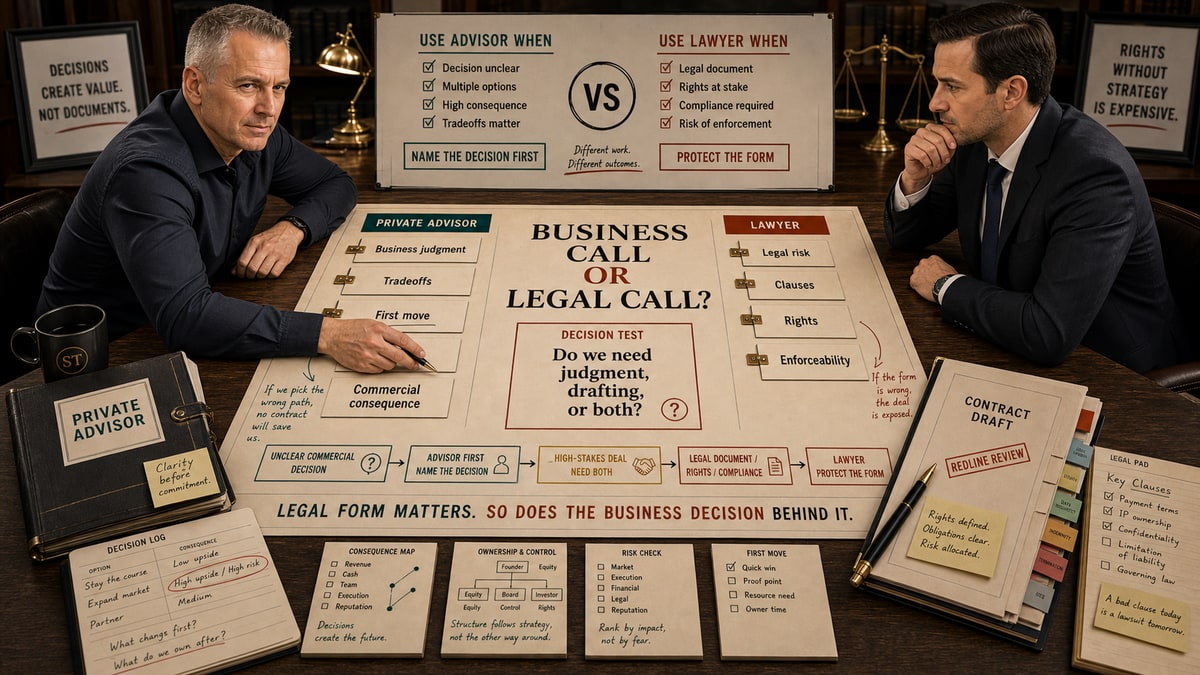
When the lawyer is right
The decision is already made and needs legal structure. You have chosen a path. The work now is documentation, protection, and enforceability. A lawyer executes against a decided course of action. That is their job and they do it well.
You are in or approaching litigation. Disputes, claims, and adversarial proceedings require legal representation. No amount of decision clarity replaces counsel in a legal proceeding.
You need a binding document. Shareholder agreements, term sheets, employment contracts, operating agreements. These require a licensed professional. A business coach has no authority here and should not pretend otherwise.
Regulatory compliance is the question. Whether a structure is legally permissible is a legal question. Whether it is strategically sound is a different question. Lawyers answer the first one. They are not trained to answer the second.
When the business coach is right
The decision itself has not been made. You are deciding whether to pursue a path at all, not how to structure the pursuit. Lawyers answer structural questions. They are not trained to help you decide whether to proceed.
The legally permissible option is not the right option. Something is allowed. That does not make it wise. The gap between legal and sound is where most expensive mistakes live. A business coach works in that gap.
The real problem is not the problem you named. Founders bring lawyers a presenting issue. The presenting issue is often a symptom. If the structural mistake underneath it is not named, the legal work produces the correct document for the wrong situation.
You need someone who can push back before the papers are signed. A lawyer's job is to execute your instruction. A business coach's job is to question whether the instruction is correct. Both are valuable. They are not the same job.
Structural differences
| Dimension | Lawyer | Business Coach |
|---|---|---|
| Primary job | Protect you from adverse legal outcomes | Catch the structural mistake before it produces an outcome |
| Accountability | Accountable to professional code and client instruction | Accountable to the accuracy of the review |
| When they engage | After the decision direction is set | Before and during the decision itself |
| What they produce | Documents, filings, structures, representation | Corrected framing, named mistakes, closed decisions |
| Incentive | Execute instructions correctly | Question whether the instruction is correct |
| Training | Legal outcomes, enforceability, liability | Operational reality, positioning, structural drift |
| Replaces the other? | No. A lawyer cannot catch the upstream mistake. | No. A business coach cannot sign the document. |
Real situations
Lawyer is right
The decision to restructure has been made. The remaining founder knows what they want the business to look like. The work is documentation, enforceability, and protecting against future dispute. This is legal work. A business coach has no meaningful role here.
Business coach is right
Both paths are legally available. Neither is obviously correct. The decision depends on what the founder is actually trying to build, what the business is structurally capable of producing, and what each path closes off permanently. A lawyer can structure either outcome. They cannot tell you which one is right.
Both, in sequence
The strategic question is whether the offer fits what the founder is trying to do and whether the structure is sound given what the business actually produces. That question belongs to a business coach. Once the direction is clear, the legal work of term sheets, reps, warranties, and closing mechanics belongs to a lawyer. The sequence matters. Legal work done before the strategic question is answered produces the correct document for the wrong situation.
Who to choose when
Most founders who think they need a lawyer first actually need the business decision named first. The legal work lands cleaner when the decision behind it is correct. The sequence is not a preference. It is practical.
Run the work yourself first
Business Coaching
Short application. Direct reply within 48 hours. The first conversation names what the company has not been able to name.
Apply nowBusiness owner coaching · No deliverables · Conversation is the product
