Comparison · Business Coach vs Accountant
Use an accountant to review the past and stay compliant. Use a business coach to test the decision that has not closed yet. An accountant reports. A business coach pressure-tests the owner decision.
An accountant addresses what the numbers say. A business coach addresses what the decision underneath the numbers actually is. Both are needed at the same time, and they sit alongside each other, not instead of each other. Confusing the two costs operators months and sometimes the company.
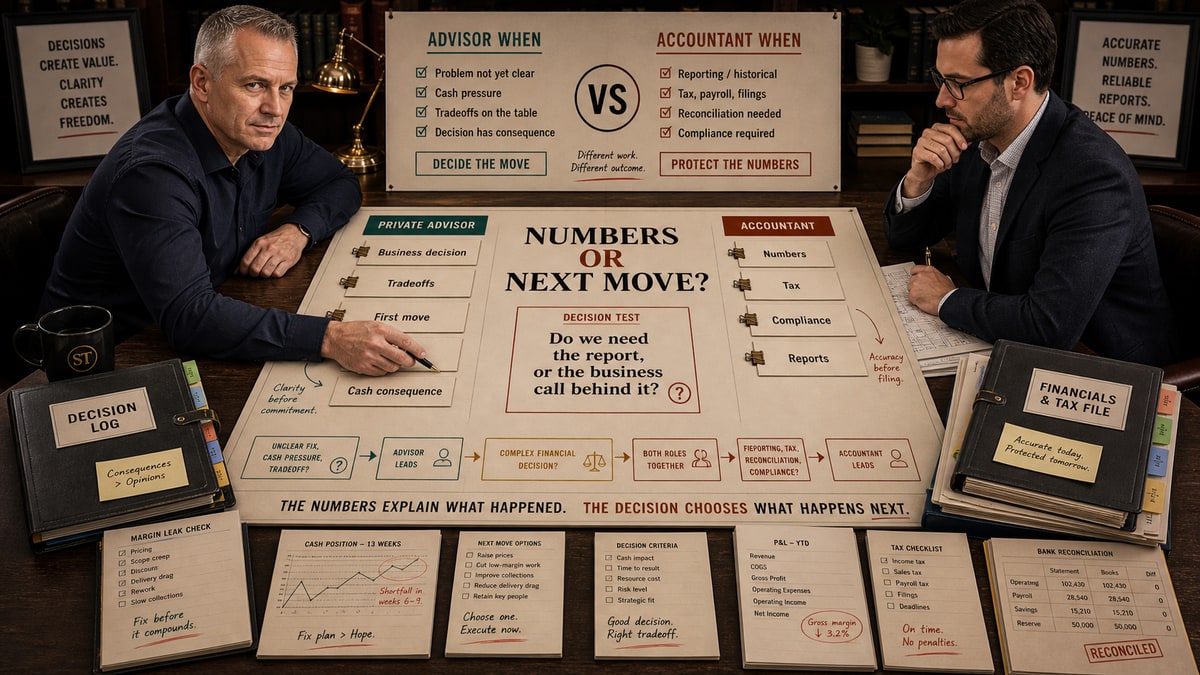
When the accountant is the right call
The financial statements need to be correct. Reconciliations, accruals, revenue recognition, classification of expenses, opening and closing entries, audit-preparedness. The accountant or controller does this work. Business coaching cannot replace it.
Tax compliance and planning at the technical level. Filings, elections, treaty positions, transfer pricing documentation, R&D credits, structuring within the tax code. CPA territory. The advisor surfaces structural questions; the accountant executes.
Producing financials for stakeholders. Monthly close, board financial packs, investor reporting, KPI dashboards built off the GL. The work is functional and recurring. A business coach pressure-tests outputs; the accountant produces them.
External audit and assurance. Statutory audits, financial-statement reviews, due-diligence support, quality-of-earnings prep. Specialist accounting work. An advisor sits adjacent to it, not inside it.
When a business coach is the right call
The metric flagged something. The question is what to do. Margin compression. Customer concentration risk. A line item that the board is going to ask about in three weeks. The accountant produced the number. The business coach pressure-tests what decision the number is asking for.
A round, an exit, a buyout offer. The accountant runs the math, the lawyer drafts the docs, the banker runs process. The business coach is the one who reviews what the deal does to the operator, the ownership split, and the board over the next ten years. The math is necessary. It is not the review.
The structure underneath the books is wrong. Wrong entity for the operating reality. Wrong cap-grid architecture for the next round. Wrong inter-company structure across jurisdictions. The accountant is correctly recording what is. The business coach pressure-tests what should be.
Whether to fire a senior leader. Whether to take the offer. Whether to step back. Decisions the books cannot answer. The numbers are sometimes inputs to these decisions. The structural business problem is the work.
The structural difference
| An accountant / CFO | A business coach | |
|---|---|---|
| Layer of work | The books, the tax position, the financial outputs | The decision underneath the books |
| Direction of review | Backward-looking and reactive. What happened, recorded correctly. | Forward-looking and structural. What shape the next decision has. |
| Specialism | Functional specialist. Deep on accounting, tax, reporting standards. | Structural business problem across operating, capital, governance, and talent. |
| Outputs | Financial statements, tax filings, board financial packs, dashboards. | The coaching conversation and written recommendation after are the product. |
| Cadence | Monthly close, quarterly reporting, annual audit, ad-hoc tax work. | Per-decision (Business Coaching) or recurring business coaching (Ongoing Coaching). |
| Authority | Books and filings sit on the accountant’s seal. Sign-off is theirs. | Names the structural business problem. The principals decide. |
| Relationship to the other | Provides the numerical inputs the business coach pressure-tests. | Surfaces the structural questions the accountant then executes. |
Accountant is the right move
Bookkeeping, controller, or fractional CFO. The work is functional accounting. Business coaching adds nothing here.
Business coach is the right move
The accountant produced the margin trend. The business coach pressure-tests what structural pattern is producing it and what decision the team has been avoiding. Business problems is the path; the work is structural, not the books.
Both, in parallel
Accountant runs quality of earnings, tax structure, working-capital adjustments, accretion modeling. Business coaching tests what the deal does to control, board composition, the next ten years of optionality, and the operator’s relationship with the team. Both are necessary. Neither replaces the other. Business coaching often shows up nearby.
An accountant and a business coach are not in competition. They sit alongside each other on most consequential decisions, on different layers of the same business drag. The skill is briefing each one with what they are built for. See ways to work.
Run the work yourself first
Apply for business coaching
Stan reviews each request for fit. Stan confirms the people, stakes, scope, and fee in writing before larger work starts.
ApplyOne-time business coaching · one-time · $1,500/month 1:1 business work · Request scope
